Beyond GPU Memory Walls the Hidden Bottlenecks Throttling Long-Context Transformer Deployments
GPU memory bandwidth, not capacity, becomes the real constraint for long-context model serving.
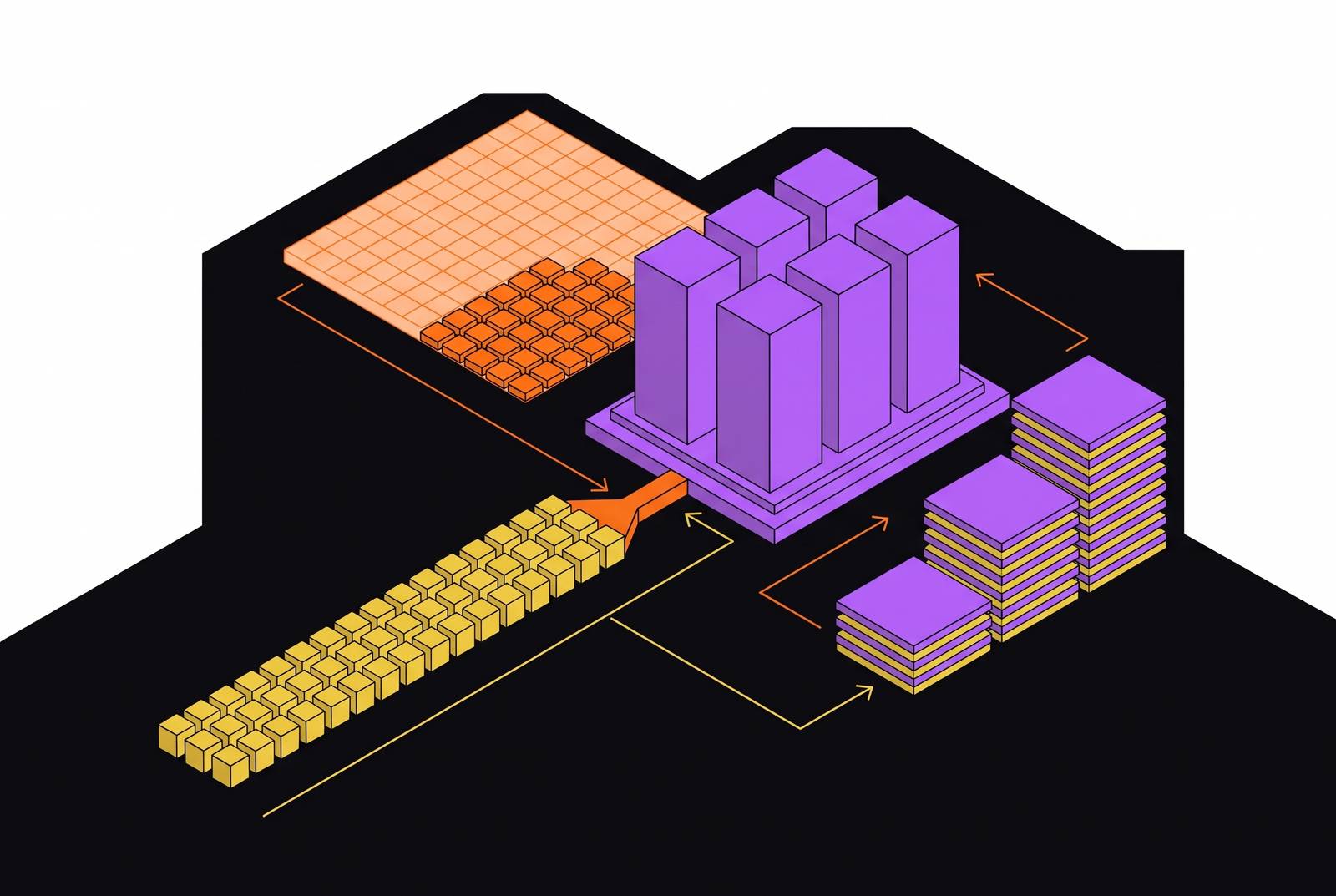
Long-context LLM serving infrastructure must provide enough GPU memory to hold KV cache data and move that data quickly. Serving long contexts at scale requires coordinated GPU memory, CPU DRAM, storage, compression, and interconnect design. At millions of tokens, efficiency depends on how these layers move data between them under concurrency, because adding capacity alone can shift the bottleneck.
Why long-context Transformer serving is harder than it looks from the GPU spec sheet
Buying more VRAM or quantizing weights is a reasonable response when a model will not fit. Neither resolves what happens after it fits. Even with FP8 quantization, serving multiple users at very long context requires multi-GPU setups, so the capacity constraint recedes without disappearing. Meanwhile, a larger resident working set still has to be read quickly enough to sustain generation.
A deployment can have enough memory and still have unacceptable token latency because the data arrives too slowly. Long-context serving turns hardware sizing into an infrastructure engineering problem, with bandwidth, cache placement, storage throughput, and interconnect latency imposing distinct limits.
How the KV cache turns context length into a data-movement problem
The KV cache avoids recomputing past token representations, but its size grows linearly with sequence length. Each decode step must read the full KV state for all earlier tokens in every layer. Longer context therefore adds both to the memory needed when a request starts and to the working set read over and over during generation. Xu et al. (2026) identify simultaneous constraints on GPU memory capacity, memory bandwidth, and inference throughput.
The sizing relationship is Memory(KV) = 2×L×H×D×T×P. Layers, KV heads, head dimension, sequence length, and precision multiply together, while concurrent requests add to the aggregate burden. Grouped Query Attention reduces KV heads and meaningfully cuts cache size in models such as Llama 3, with the reduction depending on the model. It does not remove the relationship between context length and the volume of state generation must access.
The prefill/decode split makes this harder to optimize. Long-context prefill is compute-bound, while decode is memory-bandwidth-bound, so one GPU configuration cannot be simultaneously optimal for both phases. TTKV (2026) reports that PCIe bandwidth is typically an order of magnitude lower than HBM bandwidth. Once KV state spills beyond HBM, transfers across that boundary can dominate latency. The cache has crossed not merely a capacity boundary but a much slower access path.
The six-tier GPU memory hierarchy and where long-context workloads hit each ceiling
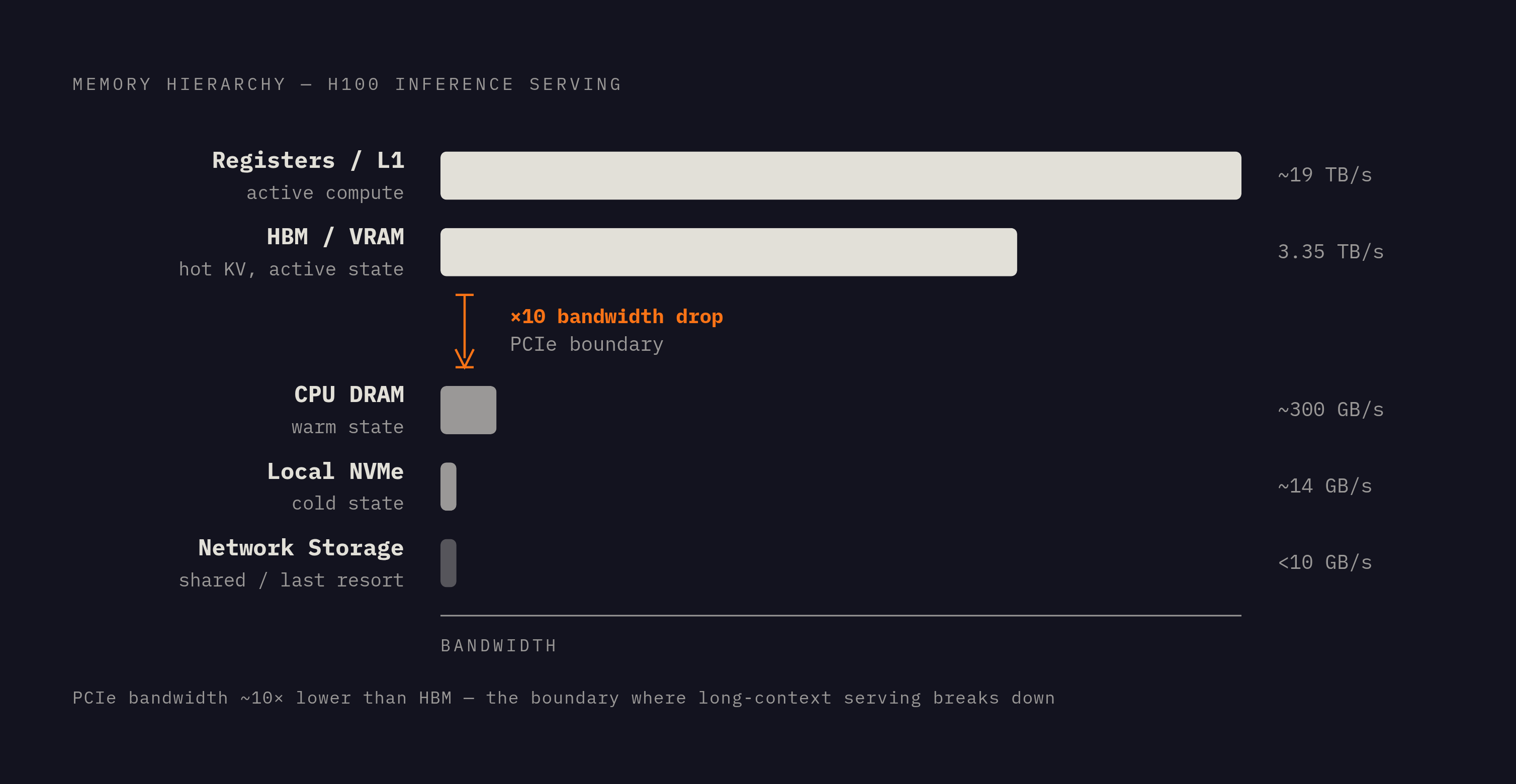
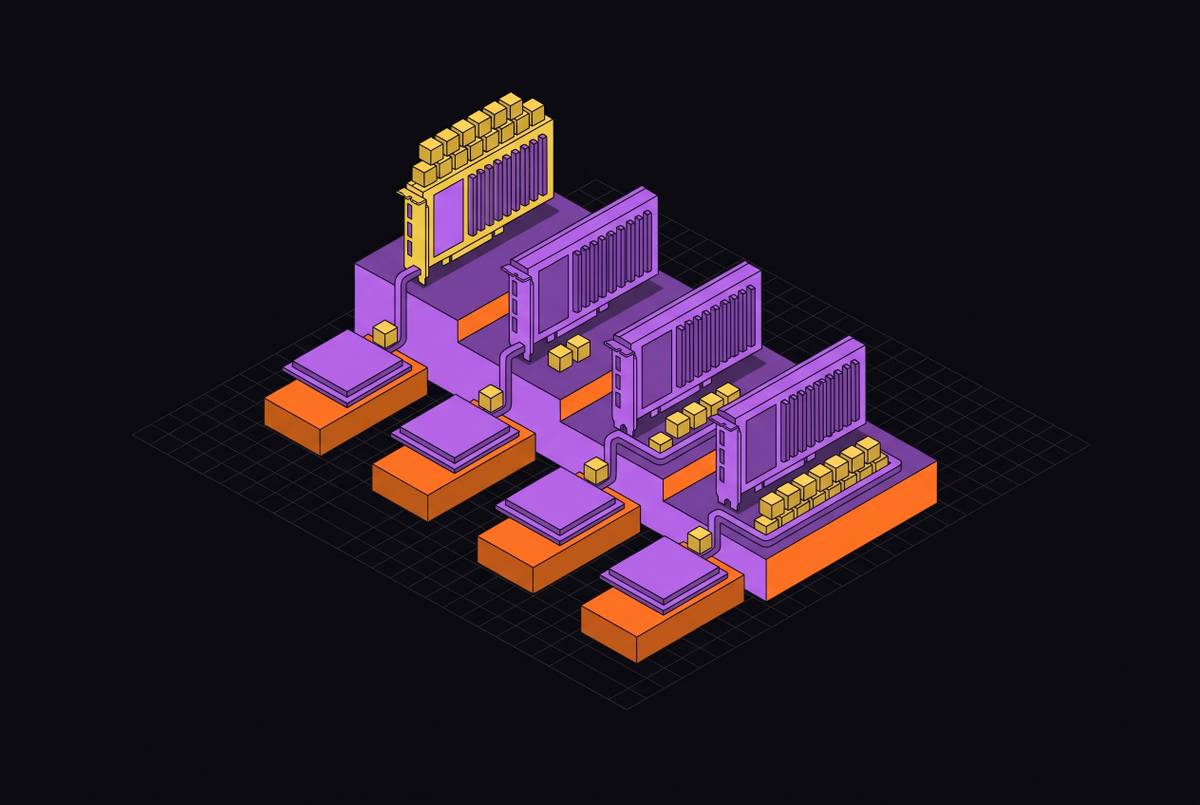
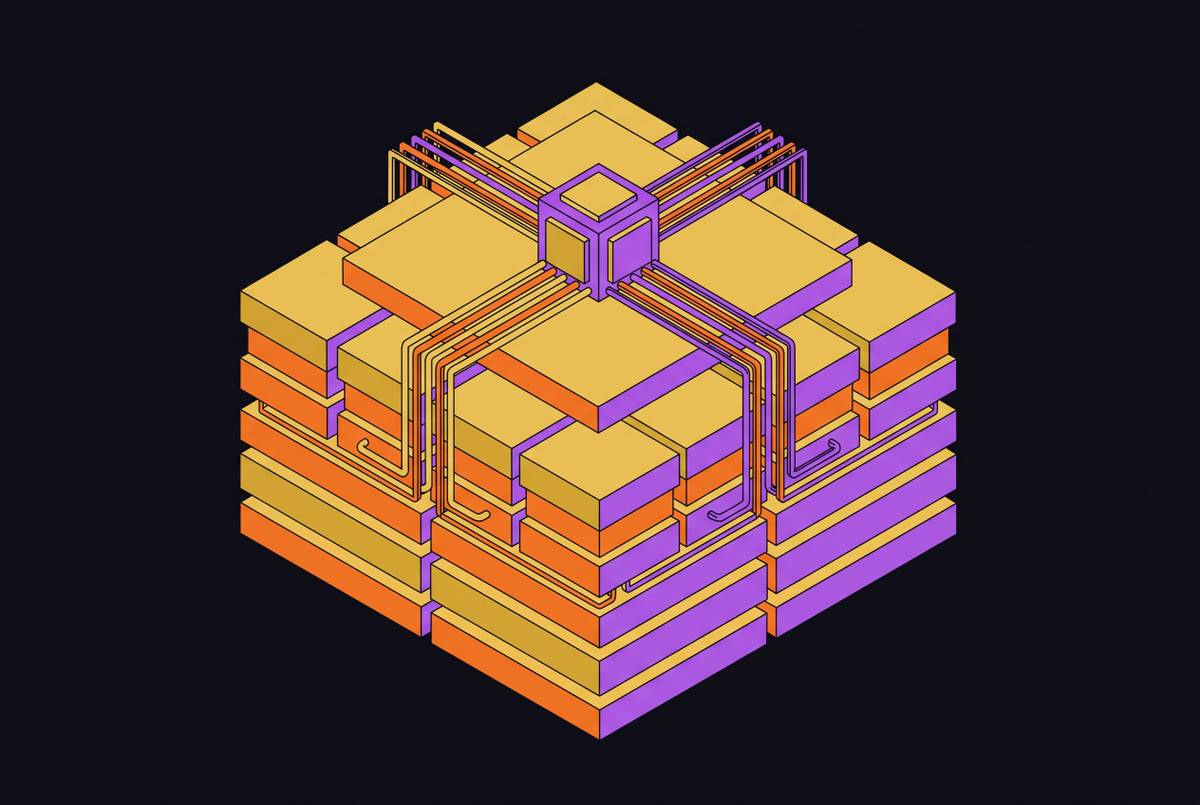
The H100 memory hierarchy spans six tiers from registers to NVMe, with physical differences in access speed spanning orders of magnitude between its fastest and slowest levels. For serving architecture, the practical map is hot KV in VRAM, warm state in CPU DRAM, cold state on local NVMe, and shared or persistent state in network storage. Each move down adds capacity but changes the cost of accessing the data. The penalties can multiply rather than behave like a small, fixed surcharge.
HBM is the hot tier for active KV state because fast decode depends on its bandwidth. Long contexts and concurrent requests fill it quickly. CPU DRAM extends available capacity, but access over PCIe encounters the bandwidth gap identified by TTKV. This changes how much it pays to add system RAM to inference nodes, which used to ship with relatively little of it. Large DRAM capacity becomes a defensible engineering choice and often the cheapest effective extension of VRAM.
Local NVMe adds capacity, but KV traffic tests more than read throughput. Frequent writes put pressure on write bandwidth and endurance, requiring datacenter-class high-DWPD drives and parallelism across multiple drives. Tier choice directly affects predictability. LMCache manages these tiers, and cache hits cut the time to first token when prompts are repeated in multi-turn chat, RAG, and agentic loops.
When KV cache offloading helps and when it makes things worse
Offloading wins only when fetching saved state costs less than the work it avoids. Below a few thousand tokens, prefill is memory-bound, and the offload round trip can cost more than recomputation. Longer contexts change that balance. As prefill becomes compute-bound, retrieving cached KV over PCIe can win decisively. Whether offloading cuts latency or just adds another transfer thus depends on context length, working-set size, and the tier the state goes to.
TTKV shows why cache reduction and offloading cannot be treated as independent switches. Their trade-offs can conflict when all states receive the same precision and placement policy. Recent states are more critical for generation, while older states can use reduced precision and slower access. TTKV assigns those states to temporal tiers and substantially reduces cross-tier traffic on long-context tasks. The gain comes from coordinating what remains precise with what remains close to the GPU.
DUAL-BLADE (ICDCS 2026) identifies another constraint below that placement decision. File-based NVMe designs relying on the kernel page cache can suffer thrashing and unpredictable latency. Its dual-path framework assigns tensors to either a page-cache path or an NVMe-direct path, mapping tensors to contiguous LBA regions to bypass the filesystem. That design substantially reduced prefill and decode latency while improving SSD utilization. The kernel itself can become the bottleneck, and network storage remains a last resort.
How KV cache compression techniques interact with the memory hierarchy
Compression cuts both the bytes that must cross tier boundaries and the space they take up at either end. It is a bandwidth optimization as well as a capacity optimization. Xu et al. organize KV optimization into cache eviction, cache compression, hybrid memory solutions, novel attention mechanisms, and combination strategies. These approaches change different parts of the access burden. Their deployment value depends on which resource limits the workload and how much task quality the technique preserves.
Eviction exploits sparse attention, in which most tokens receive little attention weight. H2O and SnapKV cut the amount of state kept by removing low-weight tokens without full recomputation. SnapKV identifies important tokens during prefill, pooling attention scores to select top-K KV positions per attention head. Yet compression ratio alone predicts little about end-to-end performance. Agrawal and Mayer (2026) found that KIVI4 provided the most stable quality across models, SnapKV delivered the strongest long-context throughput, and CaM produced large gains on selected QA workloads with substantial workload sensitivity.
AMD’s MI355X MLPerf v6.1 submission ran queries in MXFP4, reducing query-path memory traffic and allowing QKᵀ multiplication to use native FP8 tensor instructions. Lossless compression addresses a different opportunity. BF16 exponents have low entropy and compress well, unlike the higher-entropy sign and mantissa fields, and research extending ZipNN demonstrates KV compression for BF16 and FP8. These results do not make weight-loading compression equivalent to live cache compression, because the KV cache is dynamically written during inference.
Cloudflare’s April 2026 “Unweight” report targets lossless BF16 MLP weight compression, a parallel track to work on live KV traffic. Most lossless efficiency gains apply to weight tensors at load time. TTKV instead connects compression directly to the hierarchy, retaining full precision in HBM and applying differential quantization in DRAM.
Interconnect and RDMA as the hidden constraint in disaggregated serving
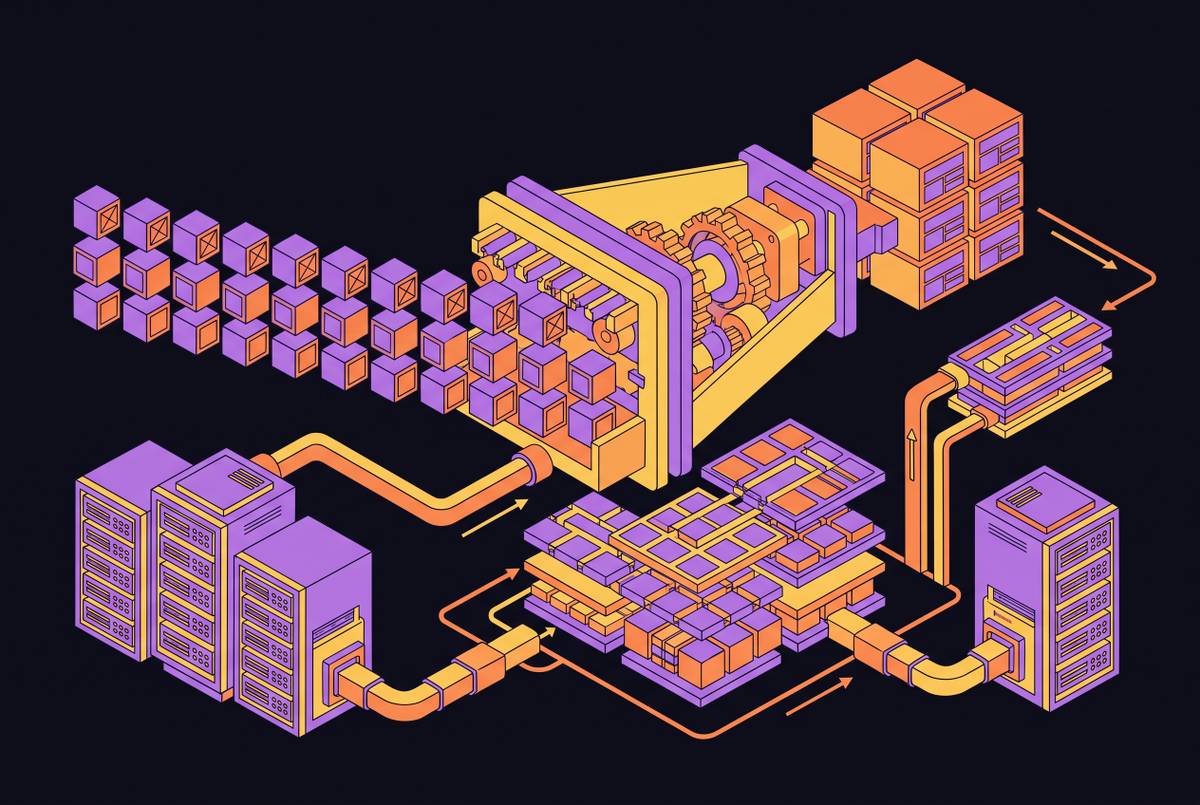
Prefill/decode disaggregation separates compute-bound and bandwidth-bound work into different hardware pools. That separation can improve throughput, but it introduces a mandatory transfer of KV state between servers. Slow transfers can consume the gains earned by specializing the pools, so interconnect selection is not a detail to resolve after the serving architecture has been chosen.
AWS uses NIXL for RDMA-based transfers between prefill and decode servers. Its layered path runs through LMCache PD, NIXL, libfabric, and Elastic Fabric Adapter, bypassing the host CPU data path through GPU-Direct RDMA. AWS testing found substantially higher tokens per second as concurrency increased compared with a standard vLLM deployment. This is a concrete deployment path. It also shows why disaggregation results depend on the infrastructure moving the cache.
NVLink provides high bandwidth within a node, InfiniBand provides a fraction of that across nodes, and TCP provides a fraction of InfiniBand across datacenters. Layer-by-layer KV transfers can overlap transmission with ongoing prefill, hiding part of the transfer latency behind computation. Faster transports hide more, while standard Ethernet overhead may reduce or eliminate disaggregation gains. CXL 3.0 memory expanders are an emerging option with more capacity than HBM and much lower latency than NVMe, while the fabric constraint still requires a solution.
How these bottlenecks compound in production: what NVIDIA ICMSP and MLPerf Storage v3.0 reveal
NVIDIA Inference Context Memory Storage Platform (ICMSP), announced at CES 2026, makes multi-tier KV management an explicit architectural concern. It standardizes storage across GPU HBM, CPU DRAM, and NVMe SSDs. BlueField-4 DPUs provide dedicated hardware support to accelerate placement and data movement and keep GPUs supplied with data from storage. IBM integrates Storage Scale with locality-aware placement on the platform, and IBM’s VP for Storage describes the integration as delivering low-latency KV access and reduced TCO.
MLCommons MLPerf Storage v3.0 (September 2026) independently formalizes the storage side of this problem. It adds KV Cache and Vector Database tests alongside restructured training and checkpointing tests. The KV test measures both read and write bandwidth at scale, simulating large populations of concurrent users across client nodes. Storage now has a distinct inference workload to answer for. A drive or storage configuration must sustain concurrent cache traffic across both reads and writes.
Kingston’s October 2026 whitepaper on the DC3000ME PCIe 5.0 NVMe reports substantially improved throughput from NVMe offloading under extreme memory pressure. That result supports the importance of the storage hardware itself. It complements rather than replaces the architectural work in ICMSP and the software-path work in DUAL-BLADE. Improving one layer leaves the next layer’s bandwidth, latency, or concurrency limit exposed.
What infrastructure should practitioners optimize for long-context serving?
The engineering priority is to match each tier boundary to the workload. Practitioners should start with context-length distribution, concurrency, and shared-prefix hit patterns. These determine which resource binds first. Multi-turn chat with repeated system prompts offers different ways to reuse the cache than a single-request RAG pipeline does.
Keeping recent states at full precision in HBM and older states at reduced precision in DRAM can cut more traffic than simple offloading. Where NVMe is required, direct-access paths that bypass the kernel page cache can reduce latency variance. Storage must also be chosen for its endurance and write bandwidth. Capacity without a stable write and retrieval path can turn the cold tier into a serving liability.
For disaggregated serving at scale, RDMA is a prerequisite, and fabric selection determines how much throughput benefit survives the KV transfer. Practitioners should use the MLPerf Storage v3.0 KV cache test to compare storage configurations under realistic inference-cache workloads. The final criterion is sustained movement of useful KV state at the required latency and concurrency. A system that can hold a million-token context is not necessarily a system that can serve it efficiently.
Sources
- TTKV: Temporal-Tiered KV Cache for Long-Context LLM Inference
- Benchmarking KV-Cache Optimizations across Task Quality and System Performance for Long-Context Serving
- KV CACHE OPTIMIZATION STRATEGIES FOR SCALABLE AND EFFICIENT LLM INFERENCE
- XKV: Personalized KV Cache Memory Reduction for Long-Context LLM Inference